
QoraDFXM
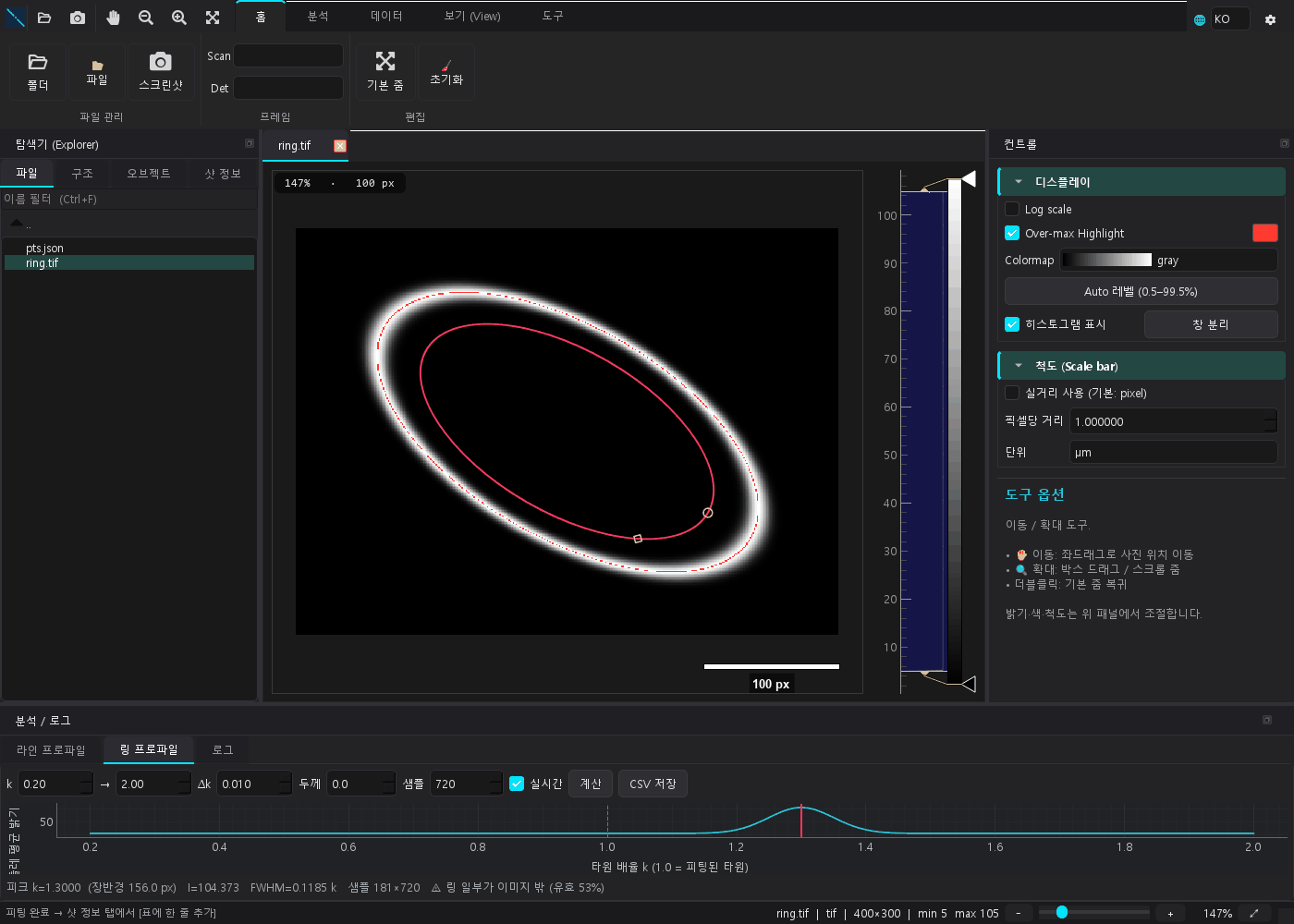
QoraDFXM measures ring-shaped features in dark-field X-ray microscopy (DFXM) detector images, shot by shot. It loads frames from HDF5 or image files, applies dark subtraction, flat-field division and display transforms, fits an ellipse to points picked on a ring, and collects the centre, axes, tilt and fit error of every shot in one table (CSV). It can also sweep the fitted ellipse outward and report the mean brightness along it, the ring profile I(k).
One pure-Python engine (qoradfxm.core, no Qt) does the work. Two front-ends call it: a command line for batch work on a beamline machine, and a PySide6 desktop app for picking points by hand. A preprocessing recipe is data, an ordered list of ops, and qoradfxm.cli.spec translates it to and from the command line's --op arguments (argv_for_dataset turns a dataset and its recipe into the equivalent qoradfxm fit arguments), so the two front-ends cannot disagree about what an op means.
Install
Python 3.14. QoraDFXM is not on PyPI; install it from GitHub with uv:
uv tool install --python 3.14 "git+https://github.com/NaNIsaac/QoraDFXM"                # engine + CLI, no Qt
uv tool install --python 3.14 "qoradfxm[gui] @ git+https://github.com/NaNIsaac/QoraDFXM"  # with the desktop app
The README's Install section has the pip and clone variants.
On a machine where uv has a free-threaded 3.14 installed (python3.14t), uv can choose it for a 3.14 request (seen with uv sync in a clone when the free-threaded build was the newer patch release), and OpenCV then fails to build because it has no free-threaded wheel. Ask for the regular build by its patch release instead, for example --python 3.14.5; uv python list shows what is installed.
First run
examples/synthetic_ring.py writes a synthetic ring image and a beamline-style HDF5 file with a dark frame, plus pts.json, eight points picked on the inner ellipse (centre 200, 150; semi-axes 120 and 60 px; 30 degrees). No measured data ships with the repository.
git clone https://github.com/NaNIsaac/QoraDFXM
cd QoraDFXM
uv sync --no-dev
uv run python examples/synthetic_ring.py
cd examples/data
uv run qoradfxm info shot.h5 --tree
uv run qoradfxm fit shot.h5 --dataset /run/scan00001/det/camera/data --points pts.json --out results.csv
uv run qoradfxm ring shot.h5 --dataset /run/scan00001/det/camera/data --op sub_bg:/dark \
    --points pts.json --k 0.5:2.0:0.005 --width 3 --out ring.csv
info --tree lists the frames and the HDF5 layout:
shot.h5: 1 frame(s)
  scan00001 / camera  (300, 400)  ->  /run/scan00001/det/camera/data
...
  dark  (1, 300, 400) float32
fit writes one row to results.csv with center_x 200.0, center_y 150.0, major_axis 240.0, minor_axis 120.0 (full diameters, not semi-axes), angle_deg 30.0 and fit_error 0.0025 px. The fit uses only the picked points; preprocessing matters to it only when a geometric op (scale, rotate, flip) moves the pixels the points refer to.
ring prints the peak of the ring profile:
peak : k=1.3000 (a·k=156.00 px) I=100.833 FWHM=0.1230 kThe synthetic ring sits at 1.3 times the fitted ellipse, so the peak is at k = 1.3. Without --op sub_bg:/dark the peak is at the same k but reads I = 120.866: the 20-count dark level of the file is still in it. The profile is always measured on linear intensity; log, sqrt and gamma ops are dropped for it unless --keep-log is given.
In Git Bash on Windows, set MSYS_NO_PATHCONV=1 first: otherwise an HDF5 path such as /run/scan00001/... is rewritten into a Windows file path and --dataset fails with component not found. PowerShell and cmd leave it alone.
To open the same file in the desktop app (needs the gui extra, or uv sync without --no-dev in a clone): qoradfxm gui shot.h5.
Where to go next
The README is the full user guide:
- CLI: every subcommand, the
--opgrammar, and what each column ofresults.csvmeans. - Python: the same steps through
QoraDFXMDataset. - Validation: the synthetic test with known truth, and how its tolerance was set.
On this site:
- Architecture: the engine, CLI and GUI layers, why the GUI runs batch work through the CLI, the immutable dataset and its recipe, which state lives where, and how the ring profile is measured.
- The Python API page lists the public functions and classes of the
qoradfxmpackage with their docstrings.