
QoraPhaseCU
QoraPhaseCU recovers a complex object from a measured 2D or 3D coherent diffraction intensity with the algorithms of QoraPhase (ER, HIO, RAAR, shrinkwrap, detwinning, many random starts), written in C++20 with a CPU reference backend and a CUDA backend behind one API. The Python package takes and returns numpy arrays and is shaped like qoraphase.reconstruct, so a QoraPhase recipe runs here unchanged and the results go back into QoraPhase for alignment, averaging and diagnostics, which QoraPhaseCU does not do itself.
It exists for speed on an NVIDIA GPU where JAX has none (JAX ships CUDA wheels for Linux only), and as an optimization study: every step from a naive port to batched, graph-launched, fp16-storage kernels and cuFFT callbacks stays a selectable variant, measured in the optimization log.
Requirements
- CMake 3.28 or later and Ninja (the CMake presets use it).
- A C++20 compiler: MSVC or gcc.
- For the CUDA backend, the CUDA Toolkit 12.8 or later. The GPU architecture defaults to the one in the build machine (
CMAKE_CUDA_ARCHITECTURES=native). - For the Python package, Python 3.12 or later and numpy 2.
Install
QoraPhaseCU is not on PyPI. The Python package is built from a clone:
git clone https://github.com/NaNIsaac/QoraPhaseCU
cd QoraPhaseCU
uv venv
uv pip install .                                          # CPU only
uv pip install . -C cmake.define.QORAPHASECU_CUDA=ON      # with the CUDA backend
pip install . works as well. The CUDA build needs the CUDA Toolkit and the compiler on the path of the shell that runs it; on Windows, that is a shell where vcvars64.bat has run and nvcc is found.
On Windows, scikit-build-core configures with the Visual Studio generator unless told otherwise, and that generator finds CUDA only through the toolkit's Visual Studio integration. A toolkit installed without it (from conda-forge, for example) fails there with No CUDA toolset found. Building with Ninja avoids this:
set CMAKE_GENERATOR=Ninja
uv pip install . -C cmake.define.QORAPHASECU_CUDA=ON
At import, qoraphasecu adds %CUDA_PATH%\bin to the DLL search path, so cuFFT is found when CUDA_PATH is set.
.github/workflows/wheels.yml builds CPU-only wheels (Linux x86_64, Windows AMD64, macOS arm64) and is run by hand; no release has been published yet. For the C++ library alone, see the README's Quick start.
First run
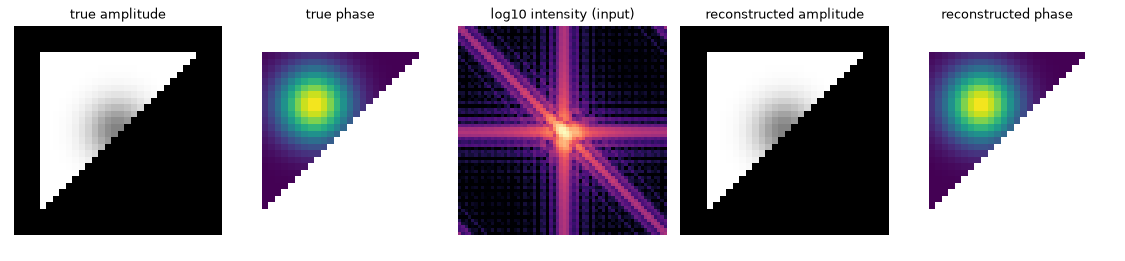
This needs no data file: it builds a small object, computes the intensity a detector would record, and reconstructs from that intensity alone, without being given a support.
import numpy as np
import qoraphasecu as qpc

# A 64x64 array holding a triangular object with a phase bump
n, m = 64, 24
inside = np.indices((m, m)).sum(0) < m
y, x = np.indices((m, m)) - (m - 1) / 2
block = inside * np.exp(1j * 1.2 * np.exp(-((x + 4) ** 2 + (y + 4) ** 2) / 30))
obj = np.zeros((n, n), np.complex64)
obj[n // 2 - m // 2 : n // 2 + m // 2, n // 2 - m // 2 : n // 2 + m // 2] = block

# Its far-field intensity, centred: this is what a detector records
intensity = np.abs(np.fft.fftshift(np.fft.fft2(np.fft.ifftshift(obj), norm="ortho"))) ** 2

print(f"CUDA device: {qpc.cuda_available()}")
ensemble = qpc.reconstruct(intensity, starts=8, seed=0)
best = ensemble.best
print(f"Fourier error {best.error:.1e} after {best.errors.size} iterations")
print(f"error against the true object {qpc.aligned_error(best.object, obj):.1e}")
The output from a CUDA build of this commit (Windows 11, Python 3.13, CUDA 13.4, RTX 5070):
CUDA device: True
Fourier error 2.5e-07 after 720 iterations
error against the true object 1.2e-06
The same run with backend="cpu" gave a Fourier error of 1.4e-07 and 3.0e-07 against the true object. Both backends draw the same random starts from the same seed, but pocketfft and cuFFT round differently and over hundreds of iterations the runs drift to different, equally valid solutions (Architecture explains this).
backend="auto", the default, runs on CUDA when the build has the CUDA backend and a device is present, and on the CPU reference otherwise; pass backend="cpu" or backend="cuda" to choose. qpc.aligned_error removes the global phase, the shift (to whole pixels) and the conjugate flip before comparing, because a reconstruction is determined only up to those. With your own data, replace the synthetic intensity with your array and read the array conventions first: the array is center-origin, it is an intensity and not an amplitude, and mask=True marks an unusable pixel.
Where to go next
The README is the full user guide:
- Composing a reconstruction: recipes,
repeat, the default recipe, shrinkwrap settings. - With QoraPhase: which QoraPhase stages convert,
to_qoraphase, and a timing against QoraPhase on the same machine. - CUDA variants: what each
variant=adds and its time per iteration. - What this does not do and Development (C++ tests, Python tests, the benchmark).
On this site:
- Architecture: the source layout, how it maps onto QoraPhase, and how the CPU and CUDA backends are kept in agreement.
- Optimization log: each CUDA step with its measured DRAM traffic, the multi-start and fp16 accuracy tables, and what was not done.
- The Python API page lists the public functions and classes of the
qoraphasecupackage with their docstrings.