
Refinement
The CNN's guess is a starting point. reflectolearn.refine.refine fits it to the measured curve by gradient descent (Adam) through the same Abeles engine the training data come from, so every parameter of the forward model, film and instrument, can be moved by the data.
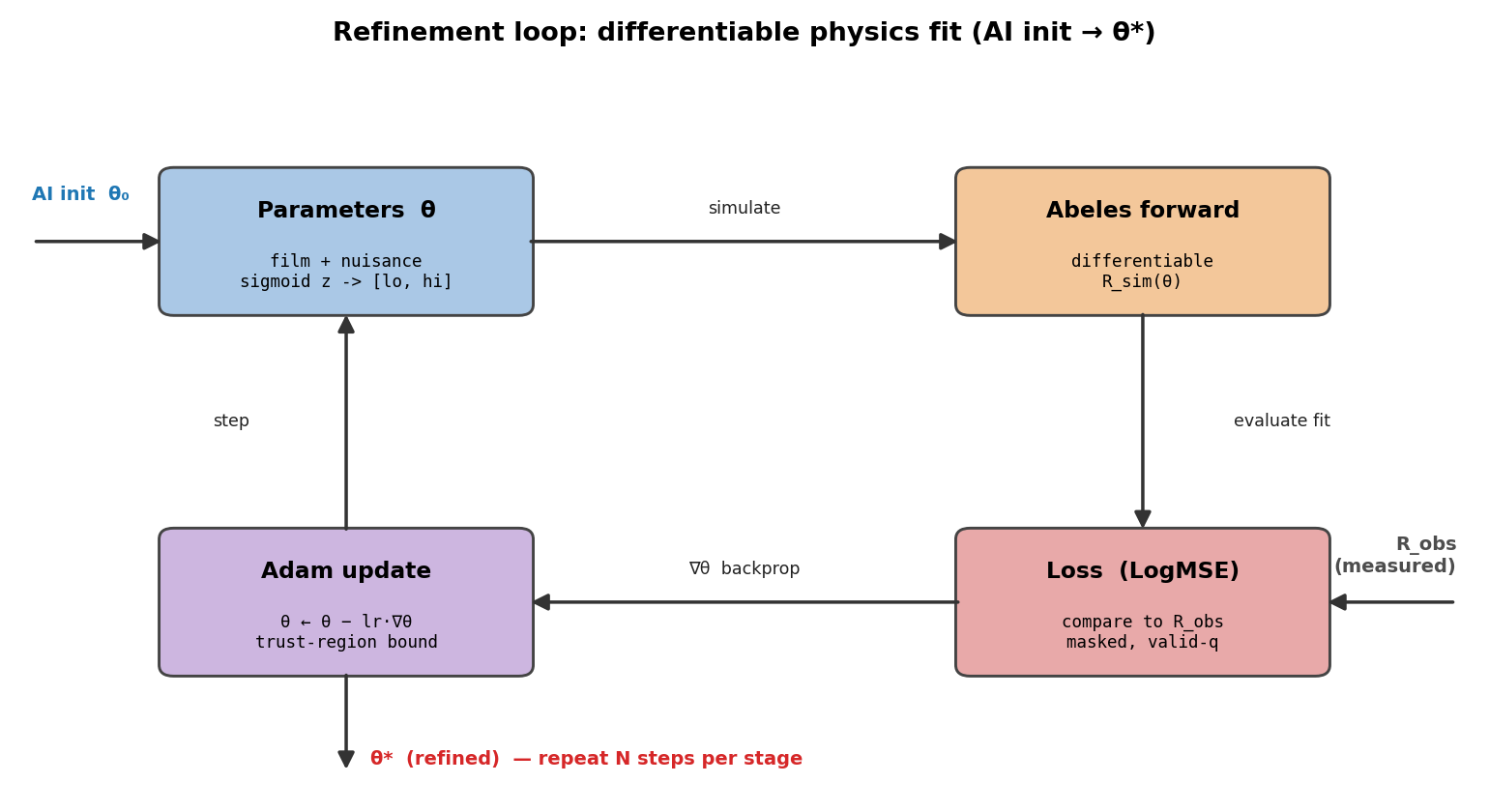
Each parameter is optimized as a latent variable mapped through a sigmoid onto its bounds, so it stays inside them throughout. The film parameters (thickness, roughness, SLD) are bounded by a trust region around the CNN's guess: half-width trust_margin (default 0.4) times the larger of the guess and 10% of the parameter's range, clipped to the global range in param_ranges. The other parameters use fixed global bounds from RefineConfig.
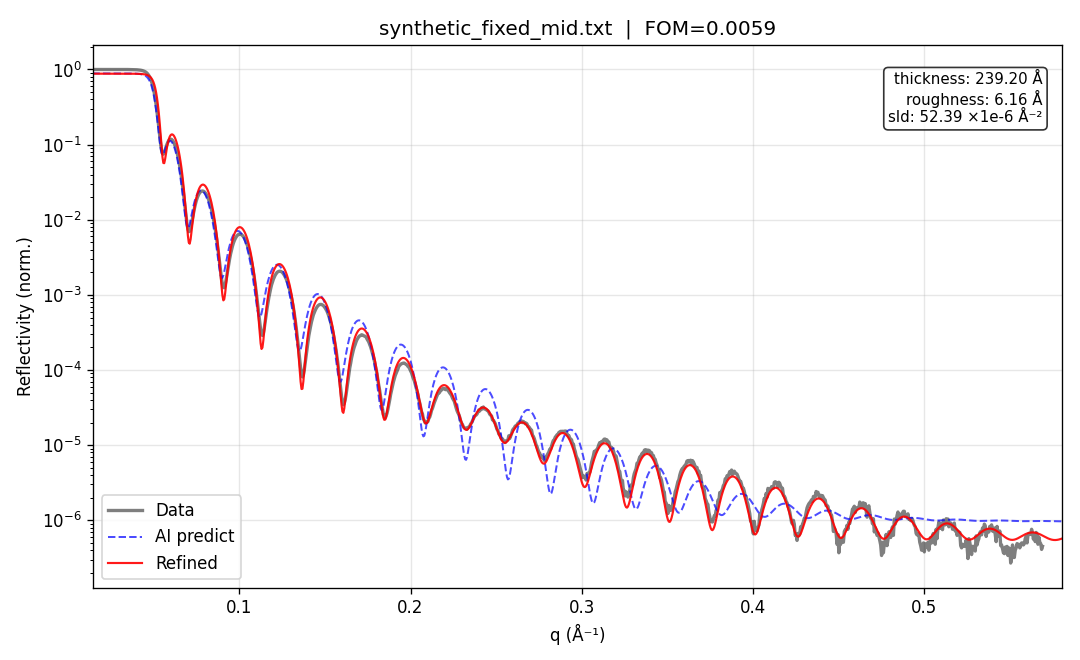
A synthetic 240 Å film (roughness 6 Å, SLD 45×10⁻⁶ Å⁻², on a 12 Å oxide over Si) with footprint, resolution, background and Poisson noise; the CNN's start (blue, dashed) and the refined fit (red), from reflectolearn predict.
What is fitted
Besides the three film parameters, the fit carries nuisance parameters: effects that change the curve but are not of interest. Fitting them stops a mismatch in the forward model from being absorbed by the film parameters.
| key | effect | RefineConfig flag | default |
|---|---|---|---|
i0 | intensity scale | fit_i0 | on |
bkg | background, log10 | fit_bkg | on |
tth_offset | 2θ zero offset, ±0.08° | fit_tth_offset | on |
dq | Gaussian resolution, constant σ_q | fit_dq | on |
dq_rel | q-proportional resolution, σ(q) = √(dq² + (dq_rel·q)²) | fit_dq_rel | off |
kalpha2_ratio | Cu Kα2 doublet | fit_kalpha2 | on |
footprint | low-angle footprint attenuation, erf(s·sin θ) | fit_footprint | on |
oxide_* | native-oxide layer on top of the film | fit_oxide | on |
The substrate is not fitted. predict fixes it to the middle of the config's substrate range.
The oxide thickness and dq carry an L2 penalty towards their "off" value (nuisance_reg, default 0.2), so they turn on only as far as the data need. With fit_dq_rel on, dq is not penalized.
Stages
The default RefineConfig().stages:
| stage | parameters | loss | steps | lr |
|---|---|---|---|---|
1.scale | i0, bkg, tth_offset, footprint | linear MSE | 120 | 0.05 |
2.structure | thickness, sld, tth_offset | correlation | 200 | 0.03 |
3.fine | everything above plus roughness, dq, dq_rel, kalpha2_ratio, oxide | log10 MSE | 300 | 0.01 |
Before the stages, i0 and bkg alone are fitted with the film held at the CNN's guess, and the log10 MSE at that point is reported as fom_before. fom_after is the log10 MSE at the end, so the difference measures what the film parameters gained, not the scale matching.
From the command line
reflectolearn predict refines by default. Its options for the fit:
| option | what it does |
|---|---|
--no-refine | skip the fit, report the CNN's guess |
--trust-margin | trust-region half-width ratio (default 0.4) |
--alias-check | experimental: also refine from half and twice the CNN thickness and from the thickness of the fringe period, then pick by fit quality plus a prior on the fringe period |
--mcmc-steps N | sample the posterior around the fit with emcee for N steps (needs the mcmc extra) |
reflectolearn evaluate --refine --trust-margin 0.4 runs the same fit on fresh simulated curves and reports metrics before and after it.
From Python
The options below have no command-line flag.
RefineConfig(tth_offset_last_stage=True)fits the 2θ offset only in the last log10-MSE stage that lists it, and also refits from that stage with the offset held at 0. The comparison is ininfo["offset_off"], and a warning is logged when holding it at 0 fits better.RefineConfig(fit_dq_rel=True)adds the q-proportional resolution term.RefineConfig.likelihood(counts_scale)replaces the stages withlikelihood_stages(): no correlation stage, a Poisson deviance instead of the log10 MSE, two polishing stages at lr 1e-3 and 1e-4, and about 30 times the default number of steps. It reaches the Poisson maximum-likelihood fit on counting data; use it on raw counts at the measured q points, not on a curve interpolated onto the model grid.refine_multistartis what--alias-checkcalls.fft_thicknessalone gives the thickness of the Kiessig fringe period, independent of the network.reflectolearn.refine.mcmc.sample_posterioris what--mcmc-stepscalls.
Known limits
These are open issues, found on synthetic curves:
- With no angular offset in the data, the default fit moves the 2θ offset towards its bound and the SLD comes out up to 30% low; the offset and the SLD are almost perfectly correlated, and the
2.structurestage slides along that valley (#14). Thickness is not affected.tth_offset_last_stageis the opt-in mitigation; it is off by default. - With the default stages, the fit stops short of the best fit even on curves from its own forward model (#25).
RefineConfig.likelihoodis the opt-in path that reaches it, at about 30 times the cost. - The posterior sampler's chains are often far shorter than 50 autocorrelation times with all twelve parameters free (#29). The result reports the autocorrelation time and a warning is logged; read the intervals with that in mind.
The synthetic film example shows the first limit on one known film and lists what that example does not cover.